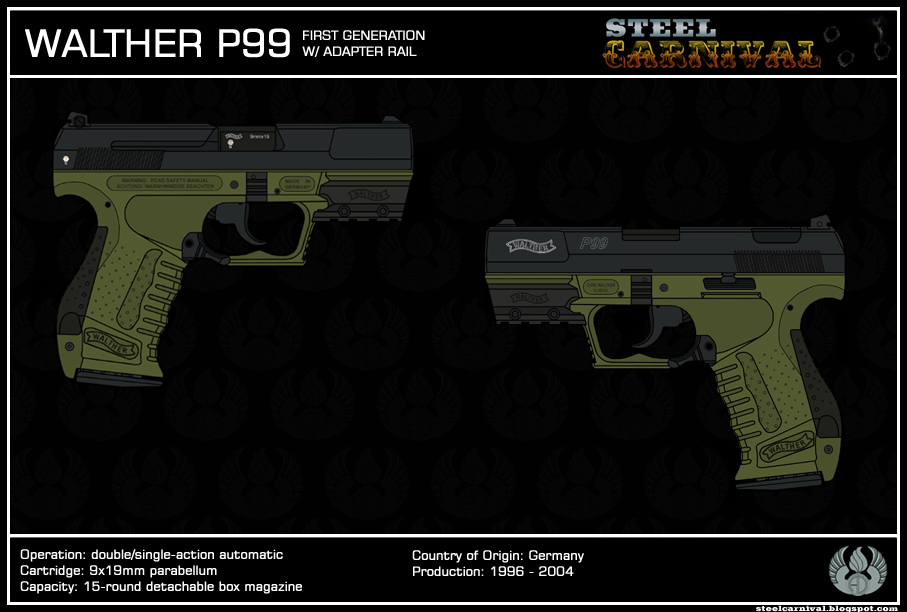
As handguns go, the Walther P99 is something of an odd duck - the magazine release is strangely placed for those of us accustomed to a thumb button (or a European heel-mounted catch) the multi-stage trigger is awkward if you shoot a double-action or striker pistol, magazines are nowhere near as common as those of the competition, and the earlier models employ a proprietary rail for which adapters or accessories are few and far between.
By accounts those three hitches would knock a pistol out of the running as a serious carry/zombie/match gun. The saving grace of the P99, however, is in the grip. In all the handguns I've picked up over the years, none sits half as comfortable as Walther's little pistol that could. Close your fingers around it and the P99 feels like it was poured in place.
Not owning one personally, I also think they look neat. Sort of that business/classy look that the Germans pull off with such aplomb.
Showing posts with label pistol. Show all posts
Smith & Wesson M&P 40
The first revolver I ever owned was a Model 10 Smith & Wesson, chambered in the ubiquitous .38 special. It was an older model with the tapered barrel, engraved down the backstrap for the Royal Hong Kong Police, and drilled at the bottom of the frame for a (missing) lanyard ring. Once outfitted with a set of beater wooden grips, it was in my estimation a neat fit for what's broadly considered one of THE service handguns of the 20th century.
Around 2005 or so I began to hear rumblings of a new Military & Police model. Later, working at a gun and pawn joint, I got my first look.
I was decidedly unimpressed.
Being a twenty-something luddite, I took umbrage at this new form of marketing witchcraft. An M&P, in my way of thinking, was a six-shot .38 special. It could come in any number of configurations - fat barrel, skinny barrel, round or square butt, any general length - but was at heart a chunk of blued forged steel with a pedigree stretching back over a century. Generations of police had carried one. The American GI might have taken an M&P up the black sand beach at Iwo Jima or on cold high-altitude bombing runs over Germany. Umpteen hundreds of thousands of Americans owned one, whether on their bedside table or in a shoebox in the closet. The Military & Police name had a history.
And this new model was none of that. Rather, it was some kind of automatic, a polymer horror of all things, chambered for 9mm and 40 S&W, and replete with all manner of gimmicks. Accessory rails! Internal locks! Multiple backstraps! High-capacity magazines!
Blasphemy.
But in fairness the new M&P really wasn't that bad. For a usurper to the name it really did bring a lot to the table. People who didn't like the shape and size of a Glock seemed to take to it well. It pointed more naturally for some. The trigger wasn't great; mostly early models were gritty and somewhat uneven, but in time those would smooth out. And no matter my opinion of the 9mm (or inexperience with .40 S&W) there was something to be said for that extra capacity.
I still toy with the idea of getting one in .45ACP.
Around 2005 or so I began to hear rumblings of a new Military & Police model. Later, working at a gun and pawn joint, I got my first look.
I was decidedly unimpressed.
Being a twenty-something luddite, I took umbrage at this new form of marketing witchcraft. An M&P, in my way of thinking, was a six-shot .38 special. It could come in any number of configurations - fat barrel, skinny barrel, round or square butt, any general length - but was at heart a chunk of blued forged steel with a pedigree stretching back over a century. Generations of police had carried one. The American GI might have taken an M&P up the black sand beach at Iwo Jima or on cold high-altitude bombing runs over Germany. Umpteen hundreds of thousands of Americans owned one, whether on their bedside table or in a shoebox in the closet. The Military & Police name had a history.
And this new model was none of that. Rather, it was some kind of automatic, a polymer horror of all things, chambered for 9mm and 40 S&W, and replete with all manner of gimmicks. Accessory rails! Internal locks! Multiple backstraps! High-capacity magazines!
Blasphemy.
But in fairness the new M&P really wasn't that bad. For a usurper to the name it really did bring a lot to the table. People who didn't like the shape and size of a Glock seemed to take to it well. It pointed more naturally for some. The trigger wasn't great; mostly early models were gritty and somewhat uneven, but in time those would smooth out. And no matter my opinion of the 9mm (or inexperience with .40 S&W) there was something to be said for that extra capacity.
I still toy with the idea of getting one in .45ACP.
Beretta M9
Retroactively posted over the complaints of my lately non-extant internet access, a subject I've been poking at for a while now. There's been a couple of things in the way - my aforementioned lousy connection (eat it, Skybeam) the many years since I've done anything more with a Beretta than looking at one through counter glass, and the perplexing difficulty of finding the correct markings and stamps for an M9 as opposed to a 92; no, Google, they are not the same, and no, dumbass, the hundred-dollar chunk of plastic you bought for your airsoft hobby is not Just Like the Real Thing (this is a complaint I will likely make many, many times - my apologies in advance).
Ahem.
My experience with the Beretta family is fairly limited. Once upon a time when I was a teenager my father bought a 92 Inox with the intent of using it for his eventual CHL class. It was a short-lived resident of the safe; neither of us had the gorilla fingers necessary to shoot one with any degree of accuracy, extra magazines were expensive, the thing was heavy, and the DA/SA operation was an annoying quirk to shooters more familiar with shooting a straight single-action autoloader. The pistol lived with us for a couple of months, ate maybe two boxes of ammo, and failed to return home from the next Saxet show.
Personally I'm not convinced the 92/M9 can do anything that a Glock can't do cheaper, lighter, and for half the price, but hey...to each their own.
Ahem.
My experience with the Beretta family is fairly limited. Once upon a time when I was a teenager my father bought a 92 Inox with the intent of using it for his eventual CHL class. It was a short-lived resident of the safe; neither of us had the gorilla fingers necessary to shoot one with any degree of accuracy, extra magazines were expensive, the thing was heavy, and the DA/SA operation was an annoying quirk to shooters more familiar with shooting a straight single-action autoloader. The pistol lived with us for a couple of months, ate maybe two boxes of ammo, and failed to return home from the next Saxet show.
Personally I'm not convinced the 92/M9 can do anything that a Glock can't do cheaper, lighter, and for half the price, but hey...to each their own.
Remington-Rand/Colt 1911A1
As a fan of the 1911 for several years now I realize I've come to develop a strong appreciation for what's commonly called the "G.I model." And, as I've learned in my on-going attempts to build my very own copy of a pistol like one that Grandpappy carried back in the war, I've come to realize two things:
a) most 1911s advertised as G.I./milspec aren't, and
b) that the best time to buy parts for the old warhorse was thirty years ago
In respect to the former I take a pretty narrow view of what I want in a pistol; I want something that, while not wholly original, could pass the ten-foot test as a specimen issued out of an armory in 1941 or thereabout and potentially carried to the far corners of the world. That means no accessory rail, correct (small) sights, no frame checkering, a proper high ejection port, and no manufacturer's billboard engraved down the slide.
In respect to the latter, this is problematic. Moreso in some respects than others. I cannot tell you the hours I spent scouring the internet for an unmolested high-port slide in good shape before I bought a depot replacement. Perhaps not what I had in mind setting out, but better than the lowered ports that come standard one most commercial GI guns (including the so-called WWII model I bought from Auto Ordnance to use as a base). The slide stop and wide-spur hammer I picked up from the parts guys when the gun show came to town. I'm still hunting a correct checkered mainspring housing.
But on the subject at hand...the as-issued 1911 is a minor work of functional art. Usually mixed and matched through arsenal rebuilds or field maintenance an original-parts gun is an extreme rarity, much to the chagrin of collectors. Certainly I'd love to own an all-matching Colt (especially with the U.S. Navy rollmarks) but in the meantime I'm content to respect the contributions of the average pistol as seen here: the mixmaster broken down, reconditioned, cobbled back together, and shipped to the hot spots of the day throughout a hundred-odd years of service.
a) most 1911s advertised as G.I./milspec aren't, and
b) that the best time to buy parts for the old warhorse was thirty years ago
In respect to the former I take a pretty narrow view of what I want in a pistol; I want something that, while not wholly original, could pass the ten-foot test as a specimen issued out of an armory in 1941 or thereabout and potentially carried to the far corners of the world. That means no accessory rail, correct (small) sights, no frame checkering, a proper high ejection port, and no manufacturer's billboard engraved down the slide.
In respect to the latter, this is problematic. Moreso in some respects than others. I cannot tell you the hours I spent scouring the internet for an unmolested high-port slide in good shape before I bought a depot replacement. Perhaps not what I had in mind setting out, but better than the lowered ports that come standard one most commercial GI guns (including the so-called WWII model I bought from Auto Ordnance to use as a base). The slide stop and wide-spur hammer I picked up from the parts guys when the gun show came to town. I'm still hunting a correct checkered mainspring housing.
But on the subject at hand...the as-issued 1911 is a minor work of functional art. Usually mixed and matched through arsenal rebuilds or field maintenance an original-parts gun is an extreme rarity, much to the chagrin of collectors. Certainly I'd love to own an all-matching Colt (especially with the U.S. Navy rollmarks) but in the meantime I'm content to respect the contributions of the average pistol as seen here: the mixmaster broken down, reconditioned, cobbled back together, and shipped to the hot spots of the day throughout a hundred-odd years of service.
Subscribe to:
Posts (Atom)